vrijdag 6 maart 2015

20150306 - fotosearch


What is Fotosearch?
Publitek, Inc., dba Fotosearch is a provider of royalty free and rights managed stock photography, illustrations, maps, video, and audio. We bring together many different stock agencies to provide "The World's Stock Photography at One Web Site."™ The products on Fotosearch can be licensed and easily downloaded for use in your advertisements, promotional materials, websites, etc. When you purchase a license to use an image, video clip, or audio clip, you do so based on the license agreement of the publisher of that particular content. The license agreement will be presented to you before purchase confirmation.


 http://www.fotosearch.com/aboutus/

donderdag 5 maart 2015

20150305 - give up sugar

What happens to your body when you give up sugar?

The brain becomes tolerant to sugar – which means more is needed to attain the same 'high'. In ways that nicotine and heroin hijack the brain’s reward pathway and make users dependent, increasing neuro-chemical and behavioural evidence suggests sugar is addictive in the same way

 
In neuroscience, food is something we call a “natural reward.” In order for us to survive as a species, things like eating, having sex and nurturing others must be pleasurable to the brain so that these behaviours are reinforced and repeated.
Evolution has resulted in the mesolimbic pathway, a brain system that deciphers these natural rewards for us. When we do something pleasurable, a bundle of neurons called the ventral tegmental area uses the neurotransmitter dopamine to signal to a part of the brain called the nucleus accumbens. The connection between the nucleus accumbens and our prefrontal cortex dictates our motor movement, such as deciding whether or not to taking another bite of that delicious chocolate cake. The prefrontal cortex also activates hormones that tell our body: “Hey, this cake is really good. And I’m going to remember that for the future.”
 Not all foods are equally rewarding, of course. Most of us prefer sweets over sour and bitter foods because, evolutionarily, our mesolimbic pathway reinforces that sweet things provide a healthy source of carbohydrates for our bodies. When our ancestors went scavenging for berries, for example, sour meant “not yet ripe,” while bitter meant “alert – poison!”
Fruit is one thing, but modern diets have taken on a life of their own. A decade ago, it was estimated that the average American consumed 22 teaspoons of added sugar per day, amounting to an extra 350 calories; it may well have risen since then. A few months ago, one expert suggested that the average Briton consumes 238 teaspoons of sugar each week.
Today, with convenience more important than ever in our food selections, it’s almost impossible to come across processed and prepared foods that don’t have added sugars for flavour, preservation, or both.
These added sugars are sneaky – and unbeknown to many of us, we’ve become hooked. In ways that drugs of abuse – such as nicotine, cocaine and heroin – hijack the brain’s reward pathway and make users dependent, increasing neuro-chemical and behavioural evidence suggests that sugar is addictive in the same way, too.

Sugar addiction is real

Anyone who knows me also knows that I have a huge sweet tooth. I always have. My friend and fellow graduate student Andrew is equally afflicted, and living in Hershey, Pennsylvania – the “Chocolate Capital of the World” – doesn’t help either of us. But Andrew is braver than I am. Last year, he gave up sweets for Lent. “The first few days are a little rough,” Andrew told me. “It almost feels like you’re detoxing from drugs. I found myself eating a lot of carbs to compensate for the lack of sugar.”
There are four major components of addiction: bingeing, withdrawal, craving, and cross-sensitisation (the notion that one addictive substance predisposes someone to becoming addicted to another). All of these components have been observed in animal models of addiction – for sugar, as well as drugs of abuse.
A typical experiment goes like this: rats are deprived of food for 12 hours each day, then given 12 hours of access to a sugary solution and regular chow. After a month of following this daily pattern, rats display behaviours similar to those on drugs of abuse. They’ll binge on the sugar solution in a short period of time, much more than their regular food. They also show signs of anxiety and depression during the food deprivation period. Many sugar-treated rats who are later exposed to drugs, such as cocaine and opiates, demonstrate dependent behaviours towards the drugs compared to rats who did not consume sugar beforehand.
Like drugs, sugar spikes dopamine release in the nucleus accumbens. Over the long term, regular sugar consumption actually changes the gene expression and availability of dopamine receptors in both the midbrain and frontal cortex. Specifically, sugar increases the concentration of a type of excitatory receptor called D1, but decreases another receptor type called D2, which is inhibitory. Regular sugar consumption also inhibits the action of the dopamine transporter, a protein which pumps dopamine out of the synapse and back into the neuron after firing.
In short, this means that repeated access to sugar over time leads to prolonged dopamine signalling, greater excitation of the brain’s reward pathways and a need for even more sugar to activate all of the midbrain dopamine receptors like before. The brain becomes tolerant to sugar – and more is needed to attain the same “sugar high.”

Sugar withdrawal is also real

Although these studies were conducted in rodents, it’s not far-fetched to say that the same primitive processes are occurring in the human brain, too. “The cravings never stopped, [but that was] probably psychological,” Andrew told me. “But it got easier after the first week or so.”
In a 2002 study by Carlo Colantuoni and colleagues of Princeton University, rats who had undergone a typical sugar dependence protocol then underwent “sugar withdrawal.” This was facilitated by either food deprivation or treatment with naloxone, a drug used for treating opiate addiction which binds to receptors in the brain’s reward system. Both withdrawal methods led to physical problems, including teeth chattering, paw tremors, and head shaking. Naloxone treatment also appeared to make the rats more anxious, as they spent less time on an elevated apparatus that lacked walls on either side.
Similar withdrawal experiments by others also report behaviour similar to depression in tasks such as the forced swim test. Rats in sugar withdrawal are more likely to show passive behaviours (like floating) than active behaviours (like trying to escape) when placed in water, suggesting feelings of helplessness.
A new study published by Victor Mangabeira and colleagues in this month’s Physiology & Behavior reports that sugar withdrawal is also linked to impulsive behaviour. Initially, rats were trained to receive water by pushing a lever. After training, the animals returned to their home cages and had access to a sugar solution and water, or just water alone. After 30 days, when rats were again given the opportunity to press a lever for water, those who had become dependent on sugar pressed the lever significantly more times than control animals, suggesting impulsive behaviour.
These are extreme experiments, of course. We humans aren’t depriving ourselves of food for 12 hours and then allowing ourselves to binge on soda and doughnuts at the end of the day. But these rodent studies certainly give us insight into the neuro-chemical underpinnings of sugar dependence, withdrawal, and behaviour.
Through decades of diet programmes and best-selling books, we’ve toyed with the notion of “sugar addiction” for a long time. There are accounts of those in “sugar withdrawal” describing food cravings, which can trigger relapse and impulsive eating. There are also countless articles and books about the boundless energy and new-found happiness in those who have sworn off sugar for good. But despite the ubiquity of sugar in our diets, the notion of sugar addiction is still a rather taboo topic.
Are you still motivated to give up sugar? You might wonder how long it will take until you’re free of cravings and side-effects, but there’s no answer – everyone is different and no human studies have been done on this. But after 40 days, it’s clear that Andrew had overcome the worst, likely even reversing some of his altered dopamine signalling. “I remember eating my first sweet and thinking it was too sweet,” he said. “I had to rebuild my tolerance.”
And as regulars of a local bakery in Hershey – I can assure you, readers, that he has done just that.

Jordan Gaines Lewis is a Neuroscience Doctoral Candidate at Penn State College of Medicine
 (This article was originally published on The Conversation. Read the original article.)

woensdag 4 maart 2015

20150304 - creatures in the gut

Mental Health May Depend on Creatures in the Gut 
 
The microbiome may yield a new class of psychobiotics for the treatment of anxiety, depression and other mood disorders

Feb 17, 2015 |By Charles Schmidt

The notion that the state of our gut governs our state of mind dates back more than 100 years. Many 19th- and early 20th-century scientists believed that accumulating wastes in the colon triggered a state of “auto-intoxication,” whereby poisons emanating from the gut produced infections that were in turn linked with depression, anxiety and psychosis. Patients were treated with colonic purges and even bowel surgeries until these practices were dismissed as quackery.
The ongoing exploration of the human microbiome promises to bring the link between the gut and the brain into clearer focus. Scientists are increasingly convinced that the vast assemblage of microfauna in our intestines may have a major impact on our state of mind. The gut-brain axis seems to be bidirectional—the brain acts on gastrointestinal and immune functions that help to shape the gut's microbial makeup, and gut microbes make neuroactive compounds, including neurotransmitters and metabolites that also act on the brain. These interactions could occur in various ways: microbial compounds communicate via the vagus nerve, which connects the brain and the digestive tract, and microbially derived metabolites interact with the immune system, which maintains its own communication with the brain. Sven Pettersson, a microbiologist at the Karolinska Institute in Stockholm, has recently shown that gut microbes help to control leakage through both the intestinal lining and the blood-brain barrier, which ordinarily protects the brain from potentially harmful agents.


 http://www.scientificamerican.com/article/mental-health-may-depend-on-creatures-in-the-gut/

dinsdag 3 maart 2015

20150303 - the goldfinch


The Goldfinch (2013) is the third novel by American author Donna Tartt, her first new book in 11 years.
 It won the Pulitzer Prize for Fiction in 2014 among other honors.

The Goldfinch is told in retrospective first-person narration by Theodore "Theo" Decker, who recounts the story of his life thus far. As a thirteen-year-old boy in New York City, Theo adores his energetic, beautiful mother — as do many other people in Manhattan. He thinks of his father, who had walked out on them a year earlier, as an alcoholic, abusive thief. Theo's life is turned upside down when he and his mother visit the Metropolitan Museum of Art to see an exhibition of Dutch masterpieces, including her favorite painting, Carel Fabritius's The Goldfinch. There, he falls in love at first sight with a red-headed girl who is accompanied by an elderly man. But then a terrorist bomb kills his mother and dozens of other art-loving citizens.
In the rubble, Theo encounters the old man, Welton "Welty" Blackwell, who gives him a ring and an enigmatic message. Believing that Welty is pointing at The Goldfinch, Theo takes it during his panicked escape. The taking of these items (one a family heirloom handed over freely, the other a literally "priceless" painting) is done by Theo in a state of terror, concussion and shock, and he has no understanding of how these seemingly minor actions will influence the rest of his life.
Alone and determined to avoid being taken in by the city as an orphan, Theo lives with a school friend, Andy Barbour, and his wealthy family (Mr. Barbour, a pleasant man as long as he takes his prescribed medication; Mrs. Barbour, a seemingly chilly but kind socialite who likes Theo; Platt, the oldest son, a boarding school bully; Andy, 14, a genius nerd; Kitsey, 9, "a candyfloss Disney Princess"; and Toddy, the youngest). Theo lives in the Barbours' elegant house for several months and is fairly happy there (despite his continuing nightmares and posttraumatic stress disorder). Unbeknownst to the Barbours, Theo carries out the last wishes of Welty and returns the ring to his family, becoming friends with James "Hobie" Hobart, Welty's partner. He also briefly encounters the red-haired girl, Pippa, who was injured in the bombing and is being sent to live with relatives in Texas. Theo feels an intense bond with her but fears he will never see her again.
Theo's life with the Barbours is shattered when his deadbeat dad, Larry Decker, arrives with his new girlfriend, Xandra, and whisks him away to Las Vegas. Theo secretly brings the painting, afraid to tell anyone about it for fear he will get in trouble.
In Las Vegas, Theo feels rootless and his father and Xandra make little effort at parenting. His father earns a living and pays for a large home outside Vegas with gambling wins. At school, Theo makes a new friend, Boris, a cosmopolitan son of a Russian émigré. The two boys both have absentee parents and spend most of their afternoons drinking alcohol, feeding themselves from shoplifted store groceries, using marijuana and other illegal drugs, talking from night to dawn, and giving friendship to Popper, Xandra's neglected Maltese puppy.
Over time, Theo's father starts to become more friendly and even asks for Theo's social security number in order to open a savings account to help him in the future. But it later becomes apparent that his father has ulterior motives — he is in debt to a crime syndicate and one day begs Theo to phone his mother's lawyer in New York to get access to money she had put aside for Theo's education. The lawyer, Mr. Bracegirdle, smells a rat and refuses to release any funds, indirectly revealing that his father had already tried using Theo's social security number and forging his signature to steal the money. Humiliated and desperate, Theo's father gets drunk and dies in a car crash.
Theo knows he must leave town at once, or be sent to a Nevada care home. He and Boris steal some money and drugs from Xandra. Boris begs him to stay one more day, but Theo wants to return to New York, and his friends, that minute. When his pleas go unheard, Boris kisses Theo and lets him go. He packs his stuff, including the package containing The Goldfinch, and leaves. After a bus ride across the country, filled with tension because Theo has decided to bring Popper, Theo returns to New York. He sees Mr. Barbour on the street, but Barbour (no longer on his medications), acts wildly and shuns him, so he can think only to go to Hobie's door. Pippa is there, as well as Hobie, and they welcome him and give him a place to stay. Pippa is only visiting, as she is at a school in Switzerland for disturbed girls, and so Theo is forced to say goodbye to her once more.
Theo's narrative now skips ahead eight years. Theo has become a full partner in Hobart's antiques and furniture-repairing business. He has concealed The Goldfinch in a storage unit because the news is full of stories about the prosecution of thieves who stole from the museum after the bombing, and he is afraid of being accused of theft. He is still in love with Pippa, but she treats him only as a close friend and is living in London with a boyfriend. He has instead formed a relationship with Kitsey Barbour, and they are planning to marry.
Theo has gotten himself into trouble, however. He is addicted to prescribed medications, which he buys on the street. He has saved Hobie from bankruptcy, but has done so by selling fake antiques (which Hobie had created for fun and had never intended for sale). Now, one of those buyers, Lucius Reeve, is attempting blackmail. Reeve has figured out that Theo was in the same museum room with The Goldfinch during the bombing and believes Theo and Hobie know its whereabouts. He threatens Theo with the consequences of revealing this information; Theo is afraid not only for himself but also for letting down the innocent and trusting Hobie.
Theo is racked by guilt and fear over the fakes and The Goldfinch. Then, a series of dramatic events take place in short succession. Theo learns, on the day before their engagement party, that Kitsey has never stopped loving Tom Cable, a criminal teenager with whom Theo attended high school, and they have an inconclusive argument about it. Boris then reappears in Theo's life, now a wealthy man on the proceeds of various dubious and unspecified activities. To Theo's astonishment, Boris reveals that he had stolen The Goldfinch from Theo while they were in high school and swapped it for a textbook of similar weight; the painting has since been used as an object of barter by various criminals and dealers. Boris feels guilty and has devoted himself to recovering the painting and returning it to Theo. The stunned Theo returns home to find Pippa unexpectedly staying there due to a cancelled flight. They go out to see a movie and have dinner, and Theo enjoys his rare time alone with her, even though it is clear by the end of the evening that Pippa feels pity for him rather than love.
At Theo and Kitsey's engagement party, Boris suddenly appears with a plan to return The Goldfinch to Theo. The plan involves flying to Amsterdam and meeting with men who are holding the painting. Theo, in a state of panic due to the presence of an associate of Lucius Reeve at the party and his anger over Kitsey's deceptions, agrees to walk out without telling anyone where he is going, leaving Pippa a note saying he loves her and a ludicrously expensive necklace as a Christmas present. In Amsterdam, Boris and his henchmen show up with guns and, at the meeting with the dealers, attack them and steal the painting, dragging the shocked Theo with them. Boris is very pleased with himself, but they are then hunted down by agents of the dealers and in a shootout, Boris is shot in the arm and Theo shoots the killer, while a boyfriend of one of the dealers escapes with the painting.
Leaving the injured Boris, the devastated Theo holes up in his Amsterdam hotel room taking drugs. His phone dead, convinced he is about to be arrested, and unable to travel having left his passport with the vanished Boris, he feels trapped, and contemplates suicide. But after several hellish days, Boris returns, and reveals that he has saved the situation by phoning the art recovery police to inform on the dealers. Not only has the painting been saved for the museum, but Boris has even received a huge reward, which he shares with Theo. He returns to New York to face the angry and devastated Hobie, who has learned the full details of Theo's selling of the fake antiques. Theo explains everything to Hobie, including The Goldfinch, which, Hobie reveals, was Welty's favourite painting too.
The novel ends with Theo travelling the world to put things right by buying back the fake antiques that he had sold. His relationship with Kitsey remains ambivalent, and Pippa has told him that she does feel love for him but that their character flaws are too similar for them to be safe together. In a lengthy reflection on what he has learned from his experiences, Theo wonders how much of his experiences were unavoidable due to fate or his character. Finally, he contemplates The Goldfinch and of "the history of people who have loved beautiful things, and looked out for them, and pulled them from the fire".


 http://en.wikipedia.org/wiki/The_Goldfinch_%28novel%29

maandag 2 maart 2015

20150302 - enough sleep

Getting Enough Sleep Can Be a Matter of Life and Death

Amidst our national sleep crisis, researchers are urgently trying to understand why we sleep and what goes wrong when we don't.


sleep1

At first, no one noticed that Joe Borelli was losing his mind — no one, that is, but Borelli himself. The trim, dark-haired radiologist was 43 years old. He ran two practices, was an assistant professor at the Medical University of South Carolina and played a ferocious game of tennis. Yet he began to have trouble recalling friends’ names, forgot to run important errands and got lost driving in his own neighborhood. He’d doze off over paperwork and awaken with drool dampening hi.....................


((The full text of this article is available to Discover Magazine subscribers))  http://discovermagazine.com/2015/april/17-wake-up-call

zondag 1 maart 2015

20150301 - spring

Spring


Spring is one of the four conventional temperate seasons, following winter and preceding summer. There are various technical definitions of spring, but local usage of the term varies according to local climate, cultures and customs. When it is spring in the Northern Hemisphere, it will be autumn in the Southern Hemisphere. At the spring equinox, days are approximately 12 hours long with day length increasing as the season progresses. Spring and "springtime" refer to the season, and also to ideas of rebirth, rejuvenation, renewal, resurrection and regrowth. Subtropical and tropical areas have climates better described in terms of other seasons, e.g. dry or wet, monsoonal or cyclonic. Often the cultures have locally defined names for seasons which have little equivalence to the terms originating in Europe.

Meteorological reckoning

Meteorologists generally define four seasons in many climatic areas: spring, summer, autumn (fall) and winter. These are demarcated by the values of their average temperatures on a monthly basis, with each season lasting three months. The three warmest months are by definition summer, the three coldest months are winter and the intervening gaps are spring and autumn. Spring, when defined in this manner, can start on different dates in different regions. In terms of complete months, in most north temperate zone locations, spring months are March, April and May, although differences exist from country to country. (Summer is June, July, August; autumn is September, October, November; winter is December, January, February). Most south temperate zone locations have opposing seasons with spring in September, October and November. Swedish meteorologists define the beginning of spring as the first occasion on which the average daytime temperature exceeds zero degrees Celsius for seven consecutive days, thus the date varies with latitude and elevation. In Australia and New Zealand, spring conventionally begins on 1 September and ends 30 November

 http://en.wikipedia.org/wiki/Spring_%28season%29

zaterdag 28 februari 2015

20150228 - star trek


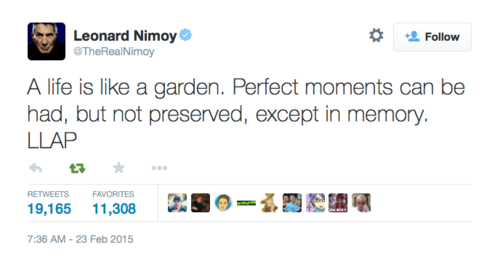
His final tweet, posted on Monday after he’d reportedly been taken to hospital suffering chest pains, is all the more poignant and heartbreaking in light of his passing.


Best known for playing Mr. Spock in the ‘Star Trek’ TV series and its subsequent movies, Nimoy enjoyed a great relationship with the show’s fanbase right up to his death, and would often end his posts on Twitter with an abbreviated version of his character’s famous catchphrase “Live long and prosper” - LLAP. 
Farewell Leonard, you certainly lived a long life and prospered. 

His wife, Susan Bay Nimoy, confirmed his death earlier today, with end-stage chronic obstructive pulmonary disease the cause of death.


 https://uk.yahoo.com/movies/read-leonard-nimoys-heartbreaking-last-tweet-112235733011.html?soc_src=mail&soc_trk=ma